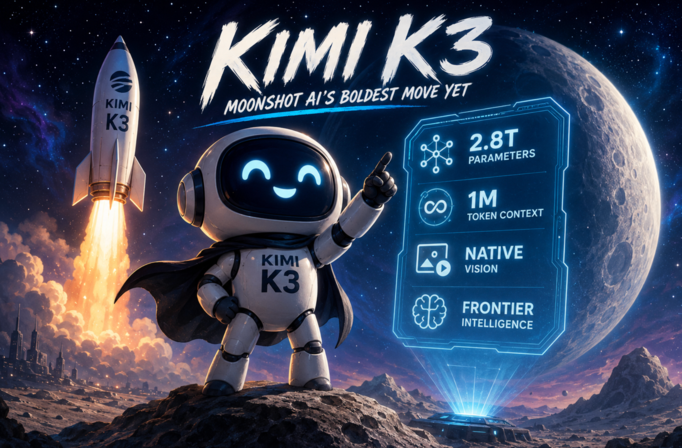
Moonshot AI has announced Kimi K3, the newest flagship in its Kimi model line and the largest open-weight model released so far (2.8-trillion-parameters). Full weights aren't out yet. Moonshot says they'll be released in ten days.
Update (October 2026): Kimi K3.1 Pro is now available. Read our Kimi K3.1 Pro guide.
The parameter count isn't really the story, though. Moonshot is a Beijing-based startup backed by Alibaba (which also makes the Qwen models, if you remember, with Qwen 3.7 as the latest), and it's been fighting for relevance as DeepSeek and other Chinese labs crowd the field.
On scale, K3 is roughly 75% larger than DeepSeek's V4. On Moonshot's own benchmarks, it beats Claude Opus 4.8 and GPT-5.5, while trailing Claude Fable 5 and GPT-5.6 Sol.
The pricing is the real signal, though. K3 charges frontier rates. That's the problem for US labs: If a Chinese model can charge the same price and perform close to the same level, it undercuts the idea that a premium price is what sets US models apart.
What Is Kimi K3?
We mentioned a bit about pricing and history. But what do we know about Kimi K3, how it's built, and how well it works?
Kimi K3 is especially well positioned for what Moonshot calls "frontier intelligence scenarios," by which it means long-horizon coding, knowledge work, and reasoning.
To that end, it supports a 1-million-token context window and native visual understanding. That second part means it can take images and video directly as input.
What's New with Kimi K3?
What's most talked about is on the surface: the 1-million-token context window and native visual understanding, which I mentioned.
To get there, Moonshot made changes on the backend across three areas:
Architecture
The model is built around two new components: Kimi Delta Attention (KDA), a hybrid linear-attention mechanism, and something called Attention Residuals (AttnRes). Both are aimed at helping information propagate more reliably through long sequences and deep networks.
On top of that, Moonshot pushed the sparsity of its Mixture-of-Experts setup further with a "Stable LatentMoE" framework, activating a small fraction of experts per forward pass. Combined with training and data changes, Moonshot claims this gives K3 roughly 2.5x the scaling efficiency of its predecessor, K2.
Coding
Moonshot is pitching K3 as strong at long-horizon engineering work: sustaining multi-step tasks with minimal supervision, navigating large codebases, and coordinating terminal tools.
It also highlights a specific niche — combining coding with visual reasoning, such as using screenshots and visual feedback to iterate on game development, frontend work, or CAD tasks. There are a lot of Kimi K3 game-development examples, like a Paper Mario-inspired game, a plane delivery game, and something that looks like Halo.
Knowledge work
Moonshot says its internal evaluations (built from real agent-collaboration workflows rather than public benchmarks) show consistent gains for Kimi K3's "max" variant across production-style knowledge work tasks.
What this adds up to for anyone actually using the model: longer documents, codebases, or video can go in as a single input instead of being chunked and stitched back together, and the same request can mix text, images, and video without extra plumbing.
The efficiency gains, if they hold up, should also mean more capability per dollar of compute than K2.
Kimi K3 API Features for Developers
The API documentation gives a clearer picture of what's changed for people actually building with the model:
-
Always-on thinking: K3 runs in thinking mode by default, configured through a top-level reasoning_effort parameter rather than the older thinking flag from the K2 line. For now, only the max effort level is supported.
-
Streaming with separated reasoning: Streaming responses expose reasoning_content and final-answer content as separate deltas, so you can show or hide the model's thinking.
-
Vision input, no public URLs: Images must be sent as base64 or via an uploaded file reference; the model doesn't accept plain image URLs, and video is handled through a separate file-upload.
-
Structured output: JSON Schema output is supported with a strict mode, but this only constrains the final content field, not the reasoning trace.
-
Partial mode: You can seed the assistant's reply with a fixed prefix and have the model continue from there. This is helpful if you want to enforce a particular opening.
-
Dynamic tool loading: Tool definitions can be injected mid-conversation via a system message, taking effect from that point in the conversation onward.
-
Automatic context caching: Caching is automatic and requires no extra parameters.
A few other limits worth flagging for anyone integrating the API: max_completion_tokens defaults to 131,072 and caps at 1,048,576, and sampling parameters like temperature and top_p are fixed rather than configurable.
Kimi is also great at browser automation tasks. Read more in our Kimi browser extension tutorial.
Kimi K3 Benchmarks: What We Know So Far
Moonshot's launch materials do include real benchmark numbers now, but we have to keep in mind different models were run through different agent harnesses. K3 was tested with Moonshot's own KimiCode; the Claude models ran through Claude Code or Terminus 2; the GPT models ran through Codex. So this isn't a clean comparison. Each lab's model is tested inside its own best-case tooling.
Here's the shape of it across three categories.
Coding
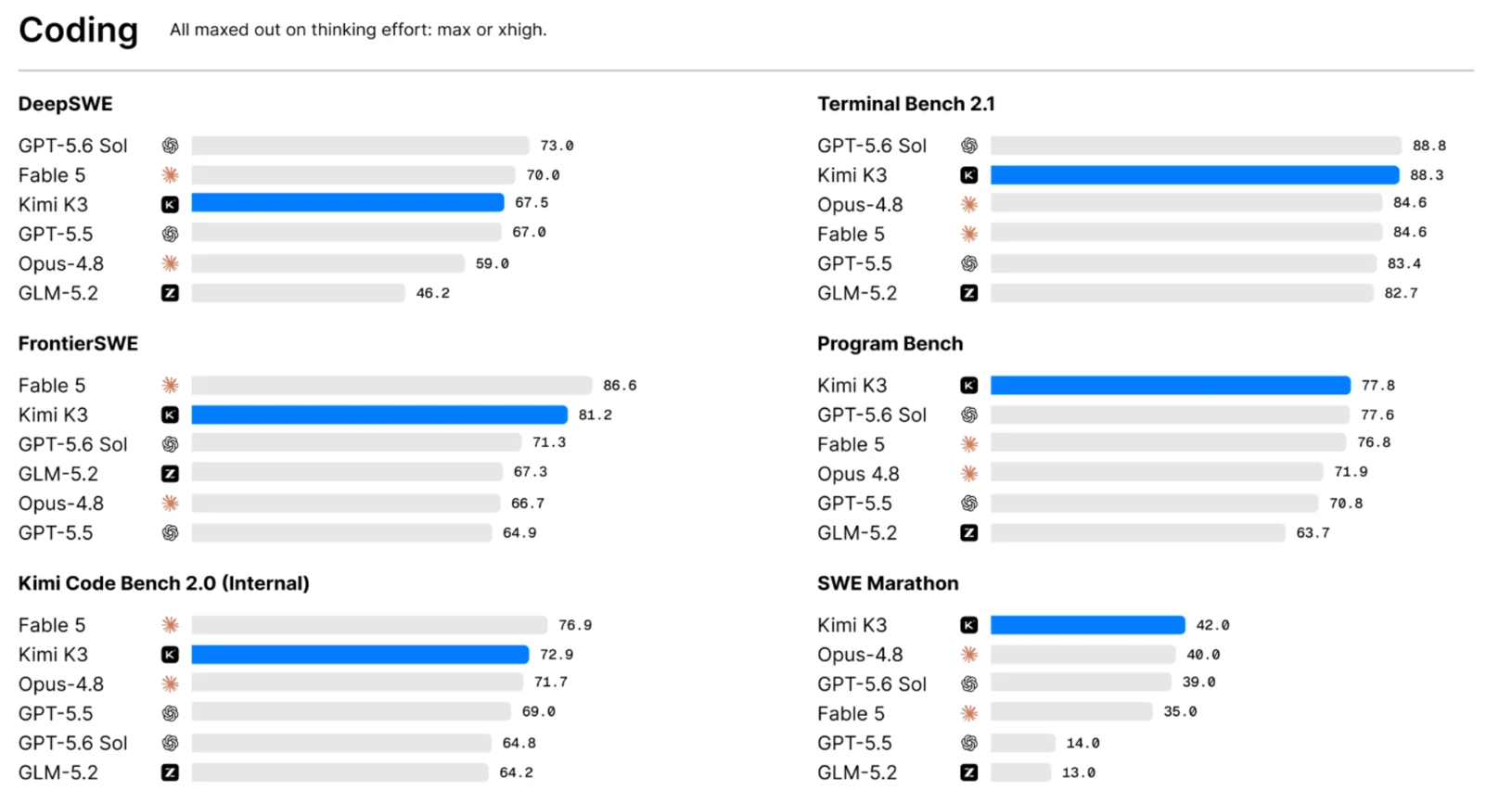
As you can see in the chart below, K3 doesn't sweep the coding benchmarks, but it's competitive almost everywhere. It leads outright on Program Bench and SWE Marathon, comes within half a point of GPT-5.6 Sol on Terminal-Bench 2.1, and beats Opus 4.8 on most of the individual tests. Where it clearly loses is DeepSWE and FrontierSWE, where Fable 5 and GPT-5.6 Sol pull ahead.
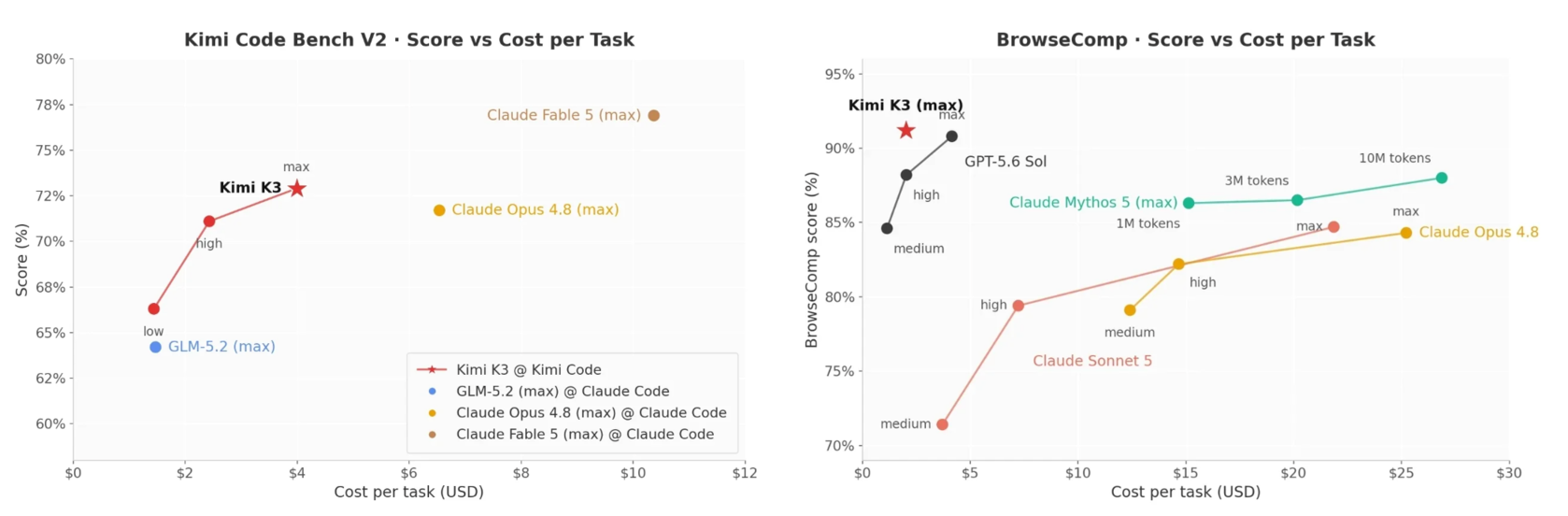
On Moonshot's own Kimi Code Bench V2 chart, K3 lands a similar score to Opus 4.8 at roughly half the cost per task, and nowhere near what Fable 5 costs for a few extra points. The BrowseComp chart tells a similar story: K3 scores higher than GPT-5.6 Sol and Claude Fable 5 while costing a fraction as much per task.
Scale, for context
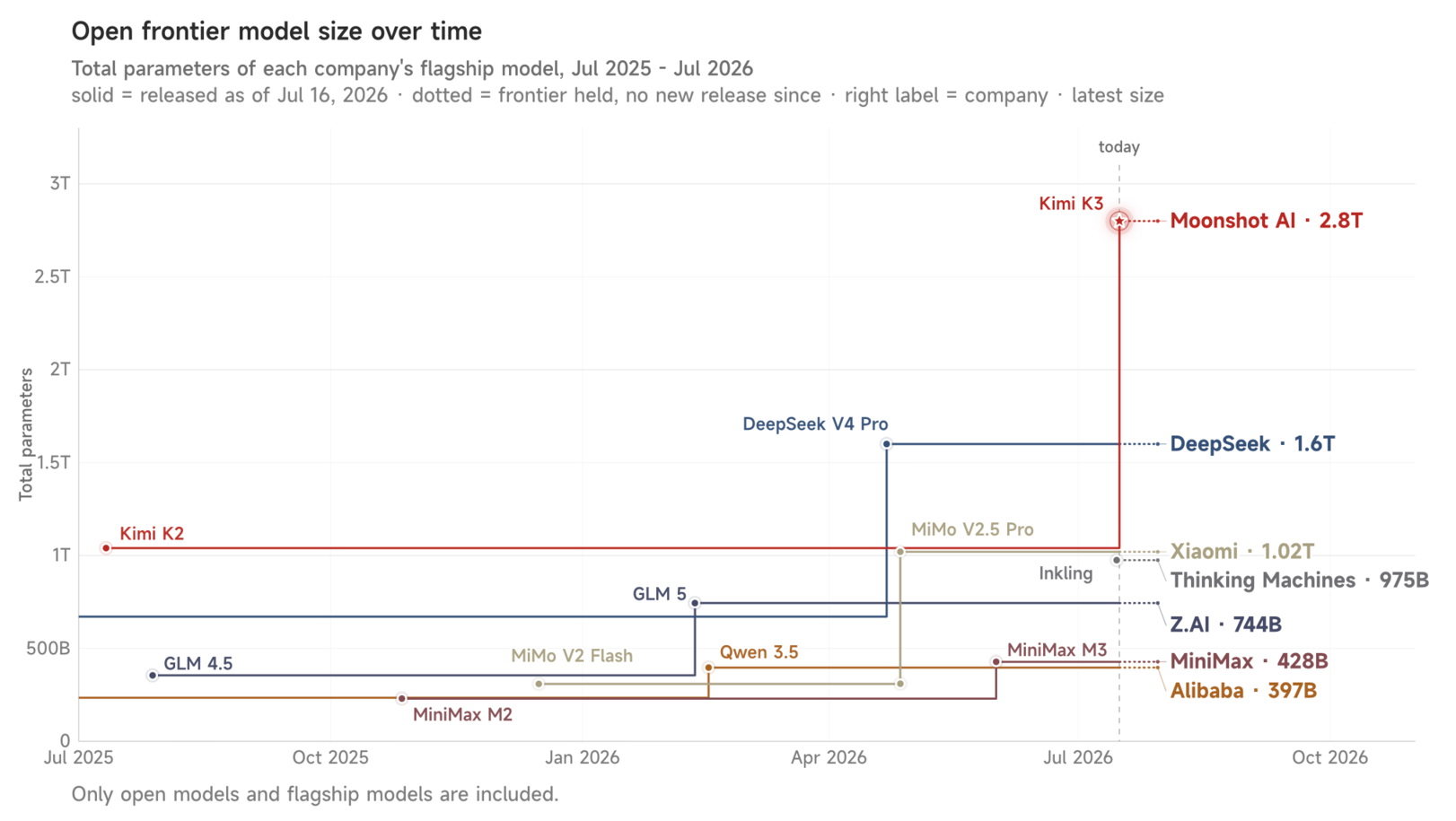
The model parameter chart is an interesting look. It's the clearest visual of the "largest open-weight model" claim from earlier in this piece, showing Moonshot jumping from Kimi K2's 1T parameters straight past DeepSeek, Xiaomi, and everyone else to 2.8T in one release.
Kimi K3 vs. Other Chinese Models
Here's how Kimi K3 stacks up against the other Chinese labs shipping models right now. At a high level, it looks like the Chinese open-weight field is splitting into two: labs like DeepSeek and Z.AI are still competing on being cheap, and Moonshot is starting to charge a higher price.
Kimi K3 vs. DeepSeek V4
DeepSeek V4 comes in smaller than K3 and is priced well below it.
K3 is making a different bet: it's bigger, and Moonshot is charging accordingly rather than trying to win on price.
Kimi K3 vs. Qwen
This comparison is interesting because Alibaba backs both Moonshot and, of course, its own Qwen line.
They are different, though: Qwen's flagship, Qwen 3.7 Max, isn't open-weight at all. It's closed, proprietary, and only usable through Alibaba's own products or third-party API hosts. Alibaba has kept releasing smaller open-weight Qwen models, but its top-tier model has moved behind closed doors.
Kimi K3 vs. GLM-5.2
GLM-5.2 is closer to the old Chinese open-source playbook: a genuinely strong model, MIT-licensed, and priced well below Western frontier rates. It's smaller than K3 and much cheaper, and it's earned a reputation for near-frontier coding performance at a fraction of the cost.
Here's how the numbers stack up, using Artificial Analysis's Intelligence Index (a composite score built from nine benchmarks, run the same way across models) as the yardstick:
| Model | Parameters | Release Date | Intelligence Index | Terminal-Bench 2.1 | Price ($/M in / out) | Open-weight? |
|---|
| DeepSeek V4 Pro | 1.6T (49B active) | Apr 24, 2026 | 44 | Not independently listed | $0.44 / $0.87 | Yes |
| Qwen 3.7 Max (Alibaba) | Undisclosed | May 20, 2026 | 56.6 | Not directly comparable | $2.50 / $7.50 | No — API only |
| GLM-5.2 (Z.AI) | 744B (40B active) | Jun 13, 2026 | 51 | 78 | $1.40 / $4.40 | Yes |
| Kimi K3 | 2.8T (16 of 896 experts active) | Jul 16, 2026 | 57 | 88.3 | $3.00 / $15.00 | Yes |
A couple of things worth flagging: Qwen 3.7 Max is included for reference, but it isn't actually open-weight, as I said, so it's not a true peer in this comparison, but it felt right to include it in the table as a reference. Also, independent, third-party verification is still catching up across the board, so nothing is final.
Kimi K3 vs. the Big US Labs
Next, let's ask how does Kimi K3 stack up against the closed, proprietary models from Anthropic and OpenAI.
Kimi K3 vs. Claude Opus 4.8
Opus 4.8 has been Anthropic's flagship for months, and on Moonshot's own numbers, K3 edges past it on several individual benchmarks, coding especially. K3 scores 88.3 on Terminal-Bench 2.1 against Opus 4.8's 84.6.
The bigger difference is this, though: Opus 4.8 is closed. K3 is open-weight, so once the weights actually ship, anyone can self-host it, fine-tune it, or run it without depending on Moonshot's servers.
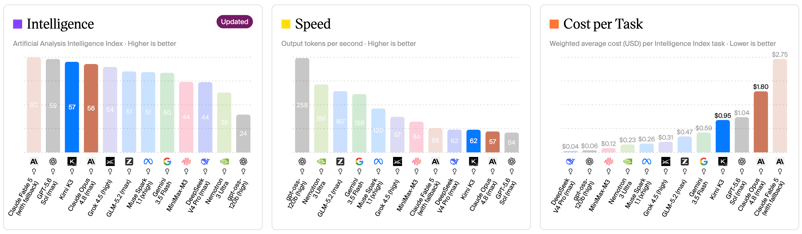
As you can see in the graphs below, K3 edges Opus 4.8 by a single point on the Intelligence Index, but the gap widens everywhere else: K3 costs about half as much per task and responds to the first token roughly 20x faster.
Kimi K3 vs. Claude Fable 5
Fable 5 is Anthropic's newest and most capable model, and it's the one K3 doesn't catch. It leads clearly on overall intelligence, and it costs considerably more to run. Fable 5 is priced at $10/$50 per million tokens against K3's $3/$15. But K3's pitch here isn't "as good as Fable 5." It's "most of the way there, for a fraction of the price."
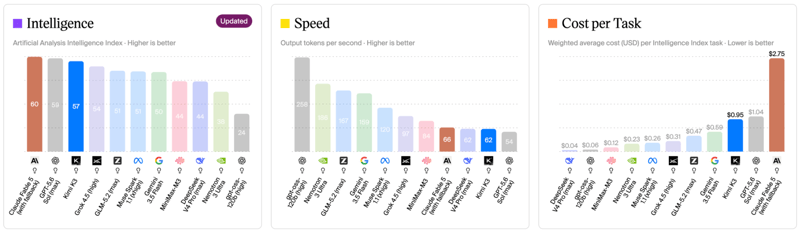
As you can see in the graphs below, Fable 5 leads comfortably on the Intelligence Index, and it's actually a touch faster than K3 on raw output speed too. Where K3 pulls ahead is cost. It runs at roughly a third of Fable 5's price per task.
Kimi K3 vs. GPT-5.5
GPT-5.5 sits just below K3 on Moonshot's own benchmarks, and it's priced in a similar range to the other US flagships and well above K3's rate.
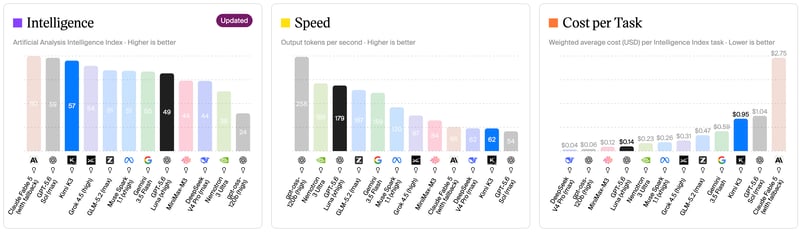
As you can see in the graphs below, K3 edges past GPT-5.5 on the Intelligence Index and costs a little less per task. GPT-5.5 actually generates tokens a bit faster once it's running, so the two trade off depending on which of those three things matters most to you.
Kimi K3 vs. GPT-5.6 Sol
GPT-5.6 Sol is OpenAI's newest and priciest model in this comparison, and on Terminal-Bench 2.1, it's essentially tied with K3. Sol scores 88.8 against K3's 88.3.
The bigger difference is the same one as with Opus 4.8: Sol is closed-weight, so you can only use it through OpenAI's own products (ChatGPT, Codex, the API), while K3 is open-weight. Once the weights ship, anyone can self-host or fine-tune it.
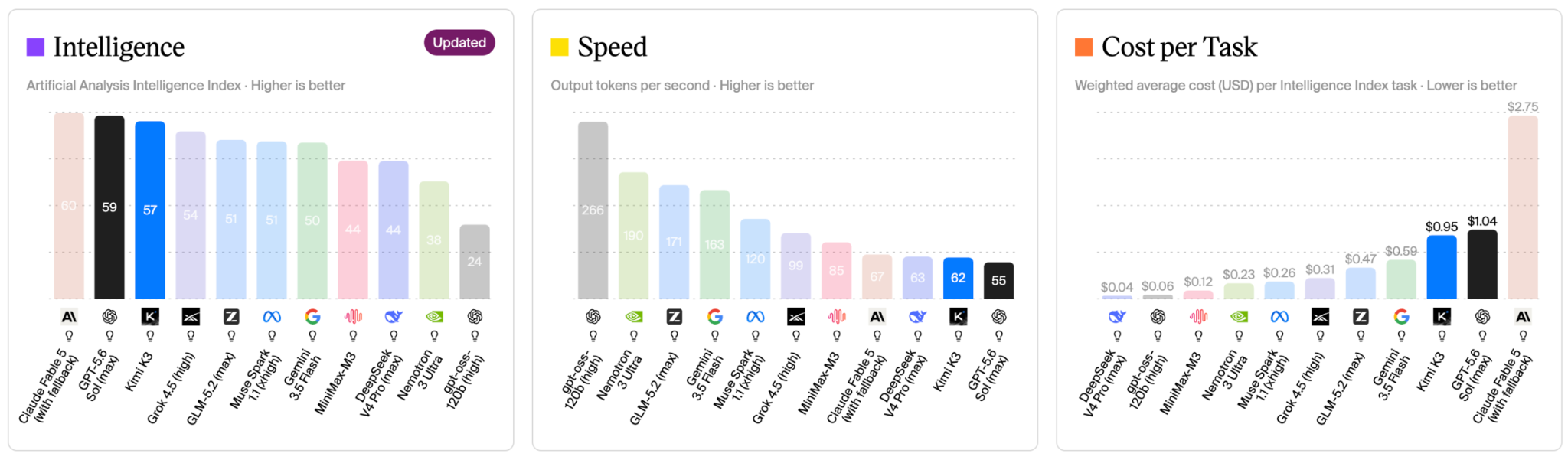
As you can see in the graphs below, Sol edges past K3 on the Intelligence Index, but K3 comes out ahead on both speed and cost.
Kimi K3 Release Date and Pricing
Kimi K3 is live now, just not fully. The model itself launched yesterday and is already usable today through kimi.com, the Kimi mobile apps, Kimi Work, Kimi Code, and the Kimi API under the model ID kimi-k3. It's also started showing up on third-party routers like OpenRouter and OrcaRouter.
What isn't out yet are the open weights themselves. Moonshot says those will be released by July 27, 2026, while the company continues working with inference partners and open-source maintainers to align technical details. Until then, you can use K3 through Moonshot's hosted services, but you can't download and self-host it.
We recommend signing up for our weekly AI newsletter, The Median, as a good way to keep up to date on model releases such as this.
On pricing, K3 uses flat pay-as-you-go billing rather than tiering by context length, despite the 1M-token window. Moonshot's official rates are $0.30 per million tokens for cache-hit input, $3.00 per million tokens for cache-miss input, and $15.00 per million tokens for output — with a cache hit rate above 90% reported for typical coding workloads, which lowers the effective input cost in practice.
Kimi K3 Limitations
Moonshot is candid in its own technical blog about limitations:
- Sensitive to thinking history: K3 was trained expecting its full reasoning trace to be passed back on every turn. If an agent harness doesn't do that correctly — or if a session gets switched over to K3 mid-conversation from a different model — output quality can get unstable. Moonshot recommends sticking to Kimi Code.
- Excessive proactiveness: On ambiguous tasks, K3 tends to make decisions on the user's behalf rather than asking. If you need it to stay inside firm boundaries, that needs to be spelled out explicitly in the system prompt.
- A UX gap, in Moonshot's own words: The model card states plainly that "K3 nonetheless exhibits a noticeable gap in user experience compared with Claude Fable 5 and GPT 5.6 Sol" — a rare instance of a lab admitting a competitor's polish advantage in its own launch materials.
- Web search flagged as unstable: Moonshot explicitly recommends against relying on web search with K3 for now, saying the feature is being updated.
Conclusion
Kimi K3 the biggest open-weight model released to date. It has a new attention architecture aimed squarely at long-context and agentic workloads. On the benchmarks that are now public, it isn't the outright winner overall — Fable 5 and GPT-5.6 Sol both edge past it — but it's extremely competitive across coding, agentic, and multimodal tasks at a fraction of the cost.
That's the throughline of this whole article: K3 isn't trying to win every category. It's trying to make the price-to-capability tradeoff hard to ignore, the same way DeepSeek did with R1 and GLM-5.2 did more recently — except this time, Moonshot is charging frontier rates to do it, not discount ones.



Moonshot AI has announced Kimi K3, the newest flagship in its Kimi model line and the largest open-weight model released so far (2.8-trillion-parameters). Full weights aren't out yet. Moonshot says they'll be released in ten days.
Update (October 2026): Kimi K3.1 Pro is now available. Read our Kimi K3.1 Pro guide.
The parameter count isn't really the story, though. Moonshot is a Beijing-based startup backed by Alibaba (which also makes the Qwen models, if you remember, with Qwen 3.7 as the latest), and it's been fighting for relevance as DeepSeek and other Chinese labs crowd the field.
On scale, K3 is roughly 75% larger than DeepSeek's V4. On Moonshot's own benchmarks, it beats Claude Opus 4.8 and GPT-5.5, while trailing Claude Fable 5 and GPT-5.6 Sol.
The pricing is the real signal, though. K3 charges frontier rates. That's the problem for US labs: If a Chinese model can charge the same price and perform close to the same level, it undercuts the idea that a premium price is what sets US models apart.
What Is Kimi K3?
We mentioned a bit about pricing and history. But what do we know about Kimi K3, how it's built, and how well it works?
Kimi K3 is especially well positioned for what Moonshot calls "frontier intelligence scenarios," by which it means long-horizon coding, knowledge work, and reasoning.
To that end, it supports a 1-million-token context window and native visual understanding. That second part means it can take images and video directly as input.
What's New with Kimi K3?
What's most talked about is on the surface: the 1-million-token context window and native visual understanding, which I mentioned.
To get there, Moonshot made changes on the backend across three areas:
Architecture
The model is built around two new components: Kimi Delta Attention (KDA), a hybrid linear-attention mechanism, and something called Attention Residuals (AttnRes). Both are aimed at helping information propagate more reliably through long sequences and deep networks.
On top of that, Moonshot pushed the sparsity of its Mixture-of-Experts setup further with a "Stable LatentMoE" framework, activating a small fraction of experts per forward pass. Combined with training and data changes, Moonshot claims this gives K3 roughly 2.5x the scaling efficiency of its predecessor, K2.
Coding
Moonshot is pitching K3 as strong at long-horizon engineering work: sustaining multi-step tasks with minimal supervision, navigating large codebases, and coordinating terminal tools.
It also highlights a specific niche — combining coding with visual reasoning, such as using screenshots and visual feedback to iterate on game development, frontend work, or CAD tasks. There are a lot of Kimi K3 game-development examples, like a Paper Mario-inspired game, a plane delivery game, and something that looks like Halo.
Knowledge work
Moonshot says its internal evaluations (built from real agent-collaboration workflows rather than public benchmarks) show consistent gains for Kimi K3's "max" variant across production-style knowledge work tasks.
What this adds up to for anyone actually using the model: longer documents, codebases, or video can go in as a single input instead of being chunked and stitched back together, and the same request can mix text, images, and video without extra plumbing.
The efficiency gains, if they hold up, should also mean more capability per dollar of compute than K2.
Kimi K3 API Features for Developers
The API documentation gives a clearer picture of what's changed for people actually building with the model:
Always-on thinking: K3 runs in thinking mode by default, configured through a top-level
reasoning_effortparameter rather than the olderthinkingflag from the K2 line. For now, only themaxeffort level is supported.Streaming with separated reasoning: Streaming responses expose
reasoning_contentand final-answercontentas separate deltas, so you can show or hide the model's thinking.Vision input, no public URLs: Images must be sent as base64 or via an uploaded file reference; the model doesn't accept plain image URLs, and video is handled through a separate file-upload.
Structured output: JSON Schema output is supported with a
strictmode, but this only constrains the finalcontentfield, not the reasoning trace.Partial mode: You can seed the assistant's reply with a fixed prefix and have the model continue from there. This is helpful if you want to enforce a particular opening.
Dynamic tool loading: Tool definitions can be injected mid-conversation via a
systemmessage, taking effect from that point in the conversation onward.Automatic context caching: Caching is automatic and requires no extra parameters.
A few other limits worth flagging for anyone integrating the API:
max_completion_tokensdefaults to 131,072 and caps at 1,048,576, and sampling parameters liketemperatureandtop_pare fixed rather than configurable.Kimi is also great at browser automation tasks. Read more in our Kimi browser extension tutorial.
Kimi K3 Benchmarks: What We Know So Far
Moonshot's launch materials do include real benchmark numbers now, but we have to keep in mind different models were run through different agent harnesses. K3 was tested with Moonshot's own KimiCode; the Claude models ran through Claude Code or Terminus 2; the GPT models ran through Codex. So this isn't a clean comparison. Each lab's model is tested inside its own best-case tooling.
Here's the shape of it across three categories.
Coding
As you can see in the chart below, K3 doesn't sweep the coding benchmarks, but it's competitive almost everywhere. It leads outright on Program Bench and SWE Marathon, comes within half a point of GPT-5.6 Sol on Terminal-Bench 2.1, and beats Opus 4.8 on most of the individual tests. Where it clearly loses is DeepSWE and FrontierSWE, where Fable 5 and GPT-5.6 Sol pull ahead.
Cost-adjusted performance
On Moonshot's own Kimi Code Bench V2 chart, K3 lands a similar score to Opus 4.8 at roughly half the cost per task, and nowhere near what Fable 5 costs for a few extra points. The BrowseComp chart tells a similar story: K3 scores higher than GPT-5.6 Sol and Claude Fable 5 while costing a fraction as much per task.
Scale, for context
The model parameter chart is an interesting look. It's the clearest visual of the "largest open-weight model" claim from earlier in this piece, showing Moonshot jumping from Kimi K2's 1T parameters straight past DeepSeek, Xiaomi, and everyone else to 2.8T in one release.
Kimi K3 vs. Other Chinese Models
Here's how Kimi K3 stacks up against the other Chinese labs shipping models right now. At a high level, it looks like the Chinese open-weight field is splitting into two: labs like DeepSeek and Z.AI are still competing on being cheap, and Moonshot is starting to charge a higher price.
Kimi K3 vs. DeepSeek V4
DeepSeek V4 comes in smaller than K3 and is priced well below it.
K3 is making a different bet: it's bigger, and Moonshot is charging accordingly rather than trying to win on price.
Kimi K3 vs. Qwen
This comparison is interesting because Alibaba backs both Moonshot and, of course, its own Qwen line.
They are different, though: Qwen's flagship, Qwen 3.7 Max, isn't open-weight at all. It's closed, proprietary, and only usable through Alibaba's own products or third-party API hosts. Alibaba has kept releasing smaller open-weight Qwen models, but its top-tier model has moved behind closed doors.
Kimi K3 vs. GLM-5.2
GLM-5.2 is closer to the old Chinese open-source playbook: a genuinely strong model, MIT-licensed, and priced well below Western frontier rates. It's smaller than K3 and much cheaper, and it's earned a reputation for near-frontier coding performance at a fraction of the cost.
Here's how the numbers stack up, using Artificial Analysis's Intelligence Index (a composite score built from nine benchmarks, run the same way across models) as the yardstick:
A couple of things worth flagging: Qwen 3.7 Max is included for reference, but it isn't actually open-weight, as I said, so it's not a true peer in this comparison, but it felt right to include it in the table as a reference. Also, independent, third-party verification is still catching up across the board, so nothing is final.
Kimi K3 vs. the Big US Labs
Next, let's ask how does Kimi K3 stack up against the closed, proprietary models from Anthropic and OpenAI.
Kimi K3 vs. Claude Opus 4.8
Opus 4.8 has been Anthropic's flagship for months, and on Moonshot's own numbers, K3 edges past it on several individual benchmarks, coding especially. K3 scores 88.3 on Terminal-Bench 2.1 against Opus 4.8's 84.6.
The bigger difference is this, though: Opus 4.8 is closed. K3 is open-weight, so once the weights actually ship, anyone can self-host it, fine-tune it, or run it without depending on Moonshot's servers.
As you can see in the graphs below, K3 edges Opus 4.8 by a single point on the Intelligence Index, but the gap widens everywhere else: K3 costs about half as much per task and responds to the first token roughly 20x faster.
Kimi K3 vs. Claude Fable 5
Fable 5 is Anthropic's newest and most capable model, and it's the one K3 doesn't catch. It leads clearly on overall intelligence, and it costs considerably more to run. Fable 5 is priced at $10/$50 per million tokens against K3's $3/$15. But K3's pitch here isn't "as good as Fable 5." It's "most of the way there, for a fraction of the price."
As you can see in the graphs below, Fable 5 leads comfortably on the Intelligence Index, and it's actually a touch faster than K3 on raw output speed too. Where K3 pulls ahead is cost. It runs at roughly a third of Fable 5's price per task.
Kimi K3 vs. GPT-5.5
GPT-5.5 sits just below K3 on Moonshot's own benchmarks, and it's priced in a similar range to the other US flagships and well above K3's rate.
As you can see in the graphs below, K3 edges past GPT-5.5 on the Intelligence Index and costs a little less per task. GPT-5.5 actually generates tokens a bit faster once it's running, so the two trade off depending on which of those three things matters most to you.
Kimi K3 vs. GPT-5.6 Sol
GPT-5.6 Sol is OpenAI's newest and priciest model in this comparison, and on Terminal-Bench 2.1, it's essentially tied with K3. Sol scores 88.8 against K3's 88.3.
The bigger difference is the same one as with Opus 4.8: Sol is closed-weight, so you can only use it through OpenAI's own products (ChatGPT, Codex, the API), while K3 is open-weight. Once the weights ship, anyone can self-host or fine-tune it.
As you can see in the graphs below, Sol edges past K3 on the Intelligence Index, but K3 comes out ahead on both speed and cost.
Kimi K3 Release Date and Pricing
Kimi K3 is live now, just not fully. The model itself launched yesterday and is already usable today through kimi.com, the Kimi mobile apps, Kimi Work, Kimi Code, and the Kimi API under the model ID
kimi-k3. It's also started showing up on third-party routers like OpenRouter and OrcaRouter.What isn't out yet are the open weights themselves. Moonshot says those will be released by July 27, 2026, while the company continues working with inference partners and open-source maintainers to align technical details. Until then, you can use K3 through Moonshot's hosted services, but you can't download and self-host it.
We recommend signing up for our weekly AI newsletter, The Median, as a good way to keep up to date on model releases such as this.
On pricing, K3 uses flat pay-as-you-go billing rather than tiering by context length, despite the 1M-token window. Moonshot's official rates are $0.30 per million tokens for cache-hit input, $3.00 per million tokens for cache-miss input, and $15.00 per million tokens for output — with a cache hit rate above 90% reported for typical coding workloads, which lowers the effective input cost in practice.
Kimi K3 Limitations
Moonshot is candid in its own technical blog about limitations:
Conclusion
Kimi K3 the biggest open-weight model released to date. It has a new attention architecture aimed squarely at long-context and agentic workloads. On the benchmarks that are now public, it isn't the outright winner overall — Fable 5 and GPT-5.6 Sol both edge past it — but it's extremely competitive across coding, agentic, and multimodal tasks at a fraction of the cost.
That's the throughline of this whole article: K3 isn't trying to win every category. It's trying to make the price-to-capability tradeoff hard to ignore, the same way DeepSeek did with R1 and GLM-5.2 did more recently — except this time, Moonshot is charging frontier rates to do it, not discount ones.